
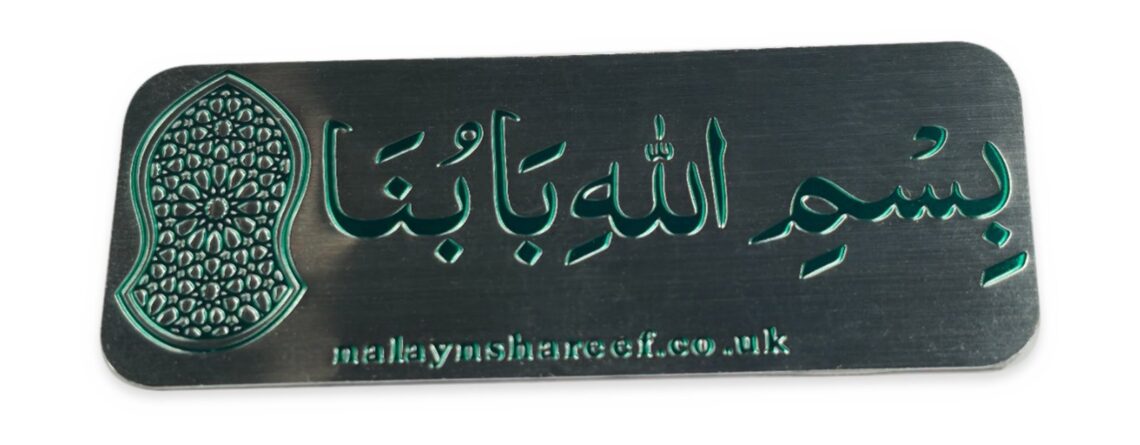
Every home has a way in. Before anyone steps over the threshold, before the day’s comings and goings begin, there is the door. That is why the words on our door plate were chosen with care: Bismillahi Babuna, “Bismillah is our door”. This short article explains where the words come from, what the scholars have said about them, and why so many families like to see them at the entrance of the home.
Where the words come from
“Bismillahi Babuna” opens a short passage in Hizb al-Bahr, the Litany of the Sea. It was composed by Imam Abu al-Hasan al-Shadhili رحمة الله تعالى عليه (593–656 AH, 1196–1258 CE), who passed away at Humaythara, in Egypt, on the road to Hajj. Hizb al-Bahr is one of the best known of his litanies.
In the Arabic text the line reads:
﴿ بِسْمِ اللَّهِ ﴾ بابُنا
“Bismillah is our door”
The passage continues by likening the home to a house built from the Qur’an: Bismillah is our door, Tabarak our walls, and Ya Sin our roof. Each part of the house is named after a part of the Book of Allah عزوجل, so the one who recites it is, in a sense, taking shelter inside the Qur’an itself.
Who said what
Imam al-Shadhili رحمة الله تعالى عليه. His early biographer, Ibn al-Sabbagh, records in Durrat al-Asrar that the Imam said of the litany: “By Allah عزوجل, I did not utter it except as it came from the Holy Prophet” ﷺ. He also told his companions that it contains the Greatest Name of Allah عزوجل.
Imam Ahmad Zarruq رحمة الله تعالى عليه. The scholar of Fez wrote a full commentary on Hizb al-Bahr. On this very line he explains:
بسم الله ندخل الأمور , ونخرج منها , وبه نتحصن من كل آفة وفتنة
“With Bismillah we enter into matters and come out of them, and through it we are fortified against every harm and trial.” Imam Ahmad Zarruq رحمة الله تعالى عليه, Sharh Hizb al-Bahr
He gives the reason simply: the door is the way in. Whatever enters a home passes through it first, so it is fitting that the door should be the name of Allah عزوجل. In the same commentary he explains that Tabarak, Surah al-Mulk, is likened to the walls because it is a fortress against enemies and gathers every benefit.
The heart and the home
One teacher of the litany puts it beautifully: a house has two meanings. There is the outer house we live in, with its door, walls and roof, and there is the inner house, the heart. Beginning every coming and going with Bismillah is a reminder that the heart, too, should only be entered in the name of Allah عزوجل.
Why place it on the door?
Placing these words at the entrance of the home is a devotional custom among those who love Hizb al-Bahr, done for barakah, so that the first thing the family and their guests pass is the name of Allah عزوجل. It is a reminder as much as an adornment: every time the door opens, the line is there to be read and recited.
Our Bismillahi Babuna door plate carries the line in Arabic calligraphy beside the geometric Nalayn Shareef design. On the new MKII edition the whole design is raised from the brushed metal and coloured, so the words stand proud of the plate and catch the light.
A gentle note
Hizb al-Bahr is a supplication. Its blessing lies in turning to Allah عزوجل with sincerity and in reciting it with understanding. A plate on the door is a beautiful reminder of that; it is the remembrance, not the metal, that matters.
Sources
- Imam Abu al-Hasan al-Shadhili رحمة الله تعالى عليه, Hizb al-Bahr.
- Ibn al-Sabbagh, Durrat al-Asrar wa Tuhfat al-Abrar, tr. Elmer H. Douglas, The Mystical Teachings of al-Shadhili.
- Imam Ahmad Zarruq رحمة الله تعالى عليه, Sharh Hizb al-Bahr (consulted through an abridgement, Tahdhib wa Ikhtisar).
- Hizb al-Bahr text and translation, under the guidance of Shaykh Muhammad al-Yaqoubi دامت برکاتہم (Damascus).
- Dawat-e-Islami media library, “Dua e Hizb ul Bahar ke Kamalaat”.
